

Get Ready for the Property Correction: Why Australian Property Owners Should Review Their Position Now

Australia’s property market is entering a period that deserves close attention. In my view, with over thirty-five (35) years of experience within the real estate sector, the correction now developing could prove more consequential for some owners than the disruption experienced during COVID-19, Y2K, the global financial crisis or the downturn of 1990-1993.
Simply this is a warning about risk, not a claim that every Australian property has already fallen or fallen further than it did in those periods. Property markets move at different speeds and the outcome will depend on interest rates, employment, credit availability and the willingness of buyers and sellers to meet at a price. The latter at the moment sees a disparity between vendor and purchaser for most asset classes, simply, why buy now when it may be cheaper in the short to medium term.
What concerns me most is the combination of stretched purchase prices of the last 5 years, higher financing costs and growing, and the gap between what some owners expect their property to be worth and what a potential buyer can justify paying today, taking into account the further tax changes and implications directed to direct property.
The signs are already visible
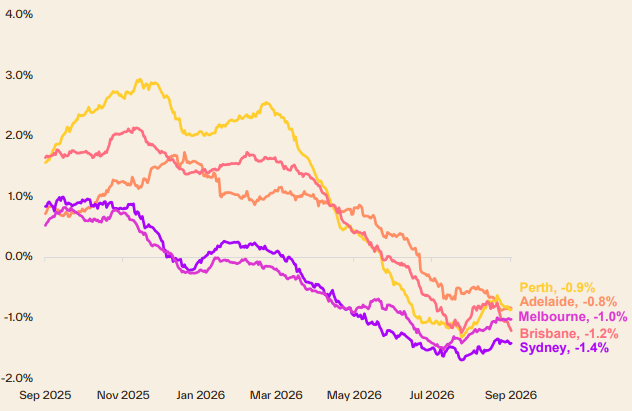
Recent housing data shows that weakness has spread beyond a single market. Cotality reported a 0.7% fall in its national Home Value Index in July 2026, with Sydney and Melbourne recording larger monthly declines. The upper end of the market was particularly weak over the three months to July. Meanwhile, the ABS reported that the number of new dwelling loan commitments fell 5.4% in the June quarter, including an 8.6% fall in private investor loan commitments. These figures do not establish the eventual depth of a correction, but they show that demand and prices are under continued and enormous pressure.
The picture is very uneven. Some locations and property types may hold up considerably better than others. Owners should resist applying headlines to asset classes. Equally, they should resist assuming that a strong sale from a year ago still sets today’s value, and there is where the problem stems for funders, owner occupiers, developers and private investors.
Why this cycle could be particularly difficult
Property values depend on actual sale prices, with few occurring in the last 12 months. They depend on what buyers can borrow, what an asset generates, the risk of owning it in comparison to the alternatives available to private investors.
When finance becomes more expensive (with further mooted increases in 2026 still expected), a purchaser’s calculations change. A buyer may require a higher return, contribute more equity or reduce their offer. An owner with a loan approaching renewal may face those same calculations from the other side of the transaction.
For commercial property, relatively small changes in rent or the initial yields can have a substantial effect on value. Consider a property earning $500,000 a year in sustainable net income:
| Valuation assumption | Indicative value |
|---|---|
| $500,000 net income at a 5% capitalisation rate | $10.0 million |
| $500,000 net income at 6% capitalisation rate | $8.33 million |
| $450,000 net income at 6% capitalisation rate | $7.50 million |
This simplified example is not a valuation of any particular property. It shows why an owner cannot assess value by looking at rent or yield in isolation. If the current market rent weakens, incentives rise (of which they are) or the return required by buyers increases, the effects can
The correction will not look the same everywhere
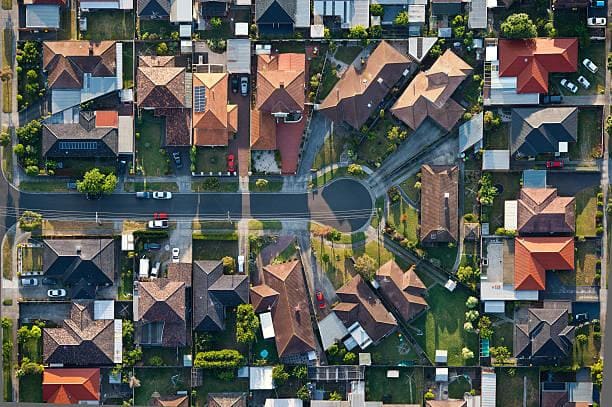
In residential markets, affordability and borrowing capacity matter greatly. The impact may be most pronounced where prices have relied on a narrow group of buyers, where purchasers are highly sensitive to finance costs, or where vendors have little room to adjust their timing.
In commercial markets, the lease often determines much of the risk. An investor will look beyond the face rent to the remaining lease term, tenant strength, incentives, outgoings, likely market rent and the cost of finding a replacement tenant. A fully leased property and a similar building facing a major vacancy can have very different prospects.
Office, retail and industrial assets should also be assessed on their own evidence. The Reserve Bank’s March 2026 review described improving fundamentals across most commercial real estate markets, while identifying weaker conditions for some lower grade offices and locations with high vacancy, including parts of Melbourne. It also reported little evidence at that time of widespread financial stress among commercial property owners. A serious warning about selected assets should therefore not be presented as proof of an existing collapse across the entire sector.

Why earlier downturns offer an incomplete guide
COVID-19, the GFC and the early 1990s each affected property through different channels. Their lessons remain useful, but owners should be careful about expecting this cycle to follow any one of them.
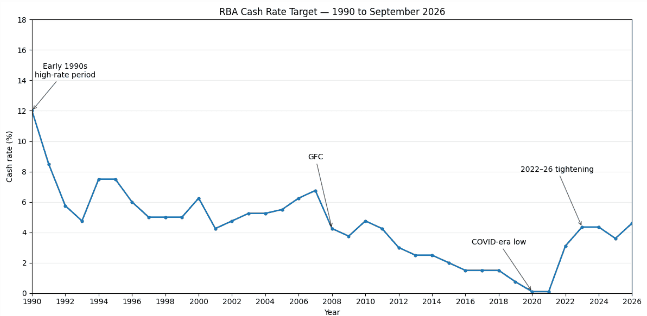
The risk today is that pressure can build gradually. A property may continue to produce income while its market value falls. A seller can defer a campaign, leaving few comparable transactions to reveal the change. A landlord can maintain a face rent while offering a large incentive, reducing the effective rent. A lender’s reassessment may bring the issue into focus before an owner has decided to sell.
That is why a market can feel stable to an owner even as buyers are repricing risk.
What should owners do now?
First, establish a current market valuation. A valuation obtained 12 months ago may reflect different sales evidence, financing conditions, rents or buyer expectations. Its relevance depends on what has happened to the asset and its market since the valuation date.
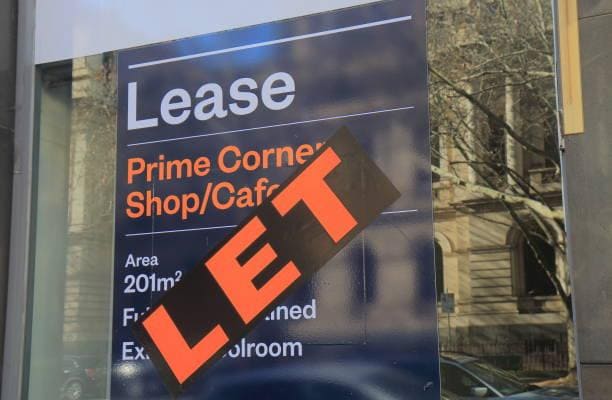
Second, examine the income received or projected rent closely. For an investment property, review lease expiries, options, rent reviews, incentives, arrears, vacancies and any expenditure needed to retain or attract tenants. The rent written in a lease is only one part of the value equation.
Third, test the debt position. Owners should understand when loans mature, how much interest costs could change and whether a lower property value would affect their refinancing options. This is especially relevant when a purchase, development or holding strategy depends on an assumed sale price. It is no use assuming a 60% loan to value ratio when the valuation is 12 months old. That 60% might be 85% in today’s market.
Fourth, decide what flexibility you have. Some owners can hold through a weaker market. Others may need to refinance, invest in the property, renegotiate a lease or sell within a defined period. Knowing which position you are in allows for a considered decision.
Finally, watch completed and settled transactions, not simply asking prices. Asking prices express expectations. Settled sales, genuine leasing evidence and the terms on which buyers are prepared to transact provide a stronger basis for assessing current market value.
Prepare, rather than speculate
I believe the possibility of a significant correction warrants action now. Whether it ultimately becomes larger than previous downturns remains to be seen. What owners can control is the quality of the information behind their decisions.
A current, independent valuation can show where an asset stands today, identify the assumptions that matter most and give owners time to consider their options. In a changing market, that knowledge is valuable whether the decision is to hold, improve, refinance or sell.
First Valuation Group provides independent valuations and property advice across residential, commercial, retail and industrial markets. If you are relying on an older valuation or are concerned about a forthcoming lease event, refinancing or sale, contact FVG to discuss an updated assessment.
To discuss any related property matter herein or other issues, please contact
Mark Ruttner, Managing Director
mr@fvg.com.au 0411 419 674

